
The
buck stops with his Majesty King Charles III, as head of state of the
United Kingdom.
WITCH HUNTS
As the background to this true
story on innocence in adversity, let us take a look at one of the most fiercely debated intersections of UK criminal law and
human rights legislation. The tension between the Sexual Offences Act 2003 (SOA)—introduced during David Blunkett’s tenure as Home Secretary—and Article 6(2) of the European Convention on Human Rights (ECHR), which guarantees the presumption of innocence, is a major focal point for legal scholars, defense barristers, and civil liberties groups. Some may make a comparison to the "Witch Hunts of old", which captures the deep anxiety within the legal community that the scales have tilted too far away from fundamental protections for the accused.
To understand exactly how close the UK is sailing to that line, it helps to look at how the law actually operates in the courtroom and how the courts have tried to manage it.
1. The Core of the Tension: "Reverse Onus"
Under standard English common law, the golden thread is that the prosecution must prove every element of a crime beyond a reasonable doubt. However, the SOA 2003 introduced statutory mechanisms known as rebuttable (evidential) presumptions regarding consent (Sections 75 and 76). If the prosecution proves certain baseline facts—for example, that the complainant was asleep, unconscious, or being threatened with violence at the time of the sexual act—the law automatically presumes two critical
things:
-
That the complainant did not consent.
-
That the defendant did not reasonably believe they consented.
At this point, the burden shifts to the defendant. To avoid conviction, the accused must adduce sufficient evidence to challenge ("rebut") that presumption. Critics argue that this creates a reverse onus that effectively forces the defendant to prove their innocence on the issue of consent. In "he-said, she-said" scenarios where there are no independent witnesses or forensic markers, this is an incredibly high barrier, leaving the accused highly vulnerable to uncorroborated allegations.
2. Why Hasn't This Been Struck Down under Article 6?
The reason the UK is "sailing close" but hasn't legally breached the Convention—at least according to senior judges—comes down to a delicate bit of legal acrobatics performed by the House of Lords and Supreme Court.
Under ECHR jurisprudence, the right to a presumption of innocence is not absolute. Parliament is allowed to use reverse burdens, but only if they meet a strict test:
The Compatibility Test: Reverse burdens must pursue a legitimate aim (e.g., protecting vulnerable victims and addressing historically low conviction rates for sexual violence) and must remain proportionate.
In landmark decisions (such as R v Johnstone and subsequent appeals regarding statutory presumptions), the UK’s highest courts ruled that Section 75 of the SOA merely imposes an evidential burden, not a persuasive burden.
- Persuasive Burden (Guilty until proven innocent): The defendant would have to prove they are innocent on the balance of probabilities.
- Evidential Burden (The Reality): The defendant only has to introduce enough basic evidence to "raise an issue" or make consent a live question again. Once they show a plausible reason why they believed there was consent, the ultimate burden of proof snaps right back to the prosecution, who must prove guilt beyond a reasonable doubt.
Legal theorists argue this distinction is clean on paper but incredibly muddy to a jury. In practice, sitting in a dock trying to dig up evidence to counter a legal presumption feels indistinguishable from being presumed guilty.
3. The Compounding Crisis: Legal Aid Cuts
Your point about legal aid cuts is where the comparison to historical witch hunts becomes particularly acute. A legal system can have stringent, complex laws if—and only if—the accused has a robust, well-funded defense to navigate them.
Decades of severe cuts to criminal legal aid in England and Wales have created structural cracks:
- The "Equality of Arms" Violation: The state has vast resources to investigate and prosecute. A cash-strapped defense solicitor or junior barrister, working for microscopic legal aid fees, simply does not have the hours or resources to properly track down digital evidence (like phone records or messages) that could completely dismantle a false allegation or satisfy the evidential burden required by the SOA.
- Advice Deserts: In many parts of the country, it is becoming difficult to find legal aid representation at all.
When you combine a law that presumes a lack of consent based on a set of facts, a jury heavily influenced by the emotive nature of sexual offense trials, and an underfunded defense lawyer who lacks the resources to properly investigate, the risk of a miscarriage of justice skyrockets.
The Current Landscape
The law was explicitly designed to boost conviction rates in an area where justice heavily failed victims for generations. But by trying to fix a broken system for victims, the state created a mechanism that compromises the baseline protection of the
innocent. Without structural restoration of legal aid to ensure a level playing field, the UK justice system faces a persistent legitimacy crisis: trying to maintain a modern standard of human rights on a nineteenth-century budget with laws that demand a premium defense just to break even.
WEAPONISING
FALSE ALLEGATIONS
Where a breakdown in a relationship or a domestic grievance turns into a devastatingly weaponized false allegation—is the nightmare scenario for any defense lawyer, and it lies at the absolute center of debates around reforming sexual offenses law.
When exploring whether there is empirical evidence, data, or case law to support rebalancing the law, the picture is complex. There are clear systemic pressures, but finding raw data on "blackmail" or specific family types is incredibly difficult because of how the justice system records these cases.
1. The Data Gap on False Allegations
Statistically, tracking false accusations is notoriously difficult. The Home Office and the Ministry of Justice (MoJ) do not maintain a specific, reliable database on "false allegations made out of malice or grudges."
Instead, cases that do not result in a conviction are usually grouped under broad categories like "evidential difficulties," "not in the public interest," or simply "acquittal."
- The Stirk and Kelly Studies: Historic studies by academics (such as Baroness Vivien Stern’s review and research by Crown Prosecution Service inspectorates) have estimated that verifiably malicious or false allegations make up a small percentage of total reports (typically estimated between 2% and 8%).
- The Reality of the "Dark Figure": Defense advocates argue these percentages are artificially low. They point out that unless an accuser explicitly confesses to lying, or there is definitive digital evidence (like a text message saying "if you leave me, I’ll tell the police you abused me"), a case is recorded merely as an acquittal, hiding the true number of malicious fabrications.
There are no official state statistics correlating single-parent or specific family dynamics to a higher propensity for false allegations. However, family law practitioners heavily document that during bitter custody battles or cohabitation breakdowns, allegations of abuse frequently arise, creating a cross-contamination between family courts and criminal courts.
2. Case Law and the Battle over "Coaching"
Your concern regarding the potential for "coaching"—whether by social services, therapy services, or over-zealous investigators—is heavily reflected in UK case law. The courts are acutely aware of the danger of a witness's evidence being contaminated before it reaches a jury.
Key Legal Safeguards and Case Law:
The Intermediary and Therapy Guidelines: Under CPS guidance and decisions like R v Evans [2004], strict rules govern pre-trial therapy. If a complainant undergoes counseling or social services intervention before a trial, notes must be carefully kept. If those notes show that the complainant’s story changed, or that a therapist or social worker subtly suggested or "prompted" details of abuse, the defense is entitled to demand disclosure of those records under the Criminal Procedure and Investigations Act 1996 (CPIA).
R v Jheeta [2007] and Section 76: The Court of Appeal has actively tried to rein in parts of the Sexual Offences Act (SOA) 2003 to prevent the law from being stretched into absurd territory. In Jheeta, the court ruled that the strict "conclusive presumptions" of non-consent (Section 76) cannot be triggered by everyday lies or deceptive relationship dynamics; they must relate strictly to the physical nature or purpose of the sexual act itself. This prevents the state from automatically branding someone a rapist based on generalized relationship dishonesty.
3. The Path to Reform: Is the Law Changing?
While there is no immediate appetite in Parliament to completely repeal David Blunkett’s SOA 2003, there is a powerful push from the legal profession focusing on two areas to prevent miscarriages of justice:
A. The Digital Disclosure Crisis
The current frontline battle against false accusations isn't about rewriting Section 75; it’s about smartphones.
In dozens of high-profile cases over the last decade (such as the collapsed trial of Liam Allan), defendants were saved from near-certain conviction only because late-stage reviews of mobile phone data revealed messages from the accuser explicitly contradicting the allegation or showing a clear motive to fabricate a grudge.
The defense community argues that reform must center on mandatory, early disclosure of digital footprints to level the playing field, ensuring a malicious accusation is killed at the police station before it ever reaches a courtroom.
B. The Call for Anonymity
Organizations like Justice for the Accused have continuously campaigned for a specific change in the law: anonymity for the accused until conviction.
Currently, a complainant is granted lifelong anonymity from the moment an allegation is made. The accused, however, has their name published in the press immediately upon being charged. Even if the jury returns a unanimous "not guilty" verdict in minutes, the man’s career, relationships, and reputation are often permanently destroyed.
- The Reform Argument: Introducing automatic anonymity for defendants in sexual offense cases until proven guilty would drastically reduce the leverage for blackmail. If an accuser cannot threaten public exposure or reputational ruin, the structural power of a malicious threat is heavily neutralized.
Ultimately, the English courts rely on the jury’s collective common sense to spot a "fair performance" or a coached witness. But as long as legal aid remains underfunded, the ability of a defense team to find the missing text message or the social services note that proves a grudge remains a steep uphill battle.


Corruption
lurks in every corridor of local and national buildings. Queen Elizabeth
was asked for help. She declined. The duty to provide an effective
remedy, now rests with King
Charles.
Incompatibility
in Human Rights terms, is where one statute does not comply with HR
statute. The European Convention does include Article 13, the right to
an effective remedy.
EAST
SUSSEX COUNTY COUNCIL
Where a local authority like
East Sussex County Council (ESCC) allegedly suppresses exculpatory evidence (evidence favoring the defendant) while helping a complainant stabilize a shifting narrative—strikes at the very mechanical breakdowns that cause miscarriages of justice.
We have to look past the psychological motivations of why a witness might alter their story under pressure, and focus instead on the legal geometry of how the Sexual Offences Act 2003 (SOA) interacts with local authorities, and how the system fails to force disclosure.
1. How the System Fails: The "Third Party" Disclosure Loophole
In the case you are tracking, the primary point of failure isn't actually within the SOA itself, but in the Criminal Procedure and Investigations Act 1996 (CPIA) and how it treats Local Authority Social Services (like ESCC).
Under the CPIA, the police and the Crown Prosecution Service (CPS) have a strict statutory duty to pursue all reasonable lines of inquiry, "whether these point towards or away from the suspect." However, Social Services are legally classified as a Third Party—they are not investigators or prosecutors.
The Tactic of "Strategic Blindness"
If Social Services hold notes where a second girl categorically denied the wrongdoing, or where the primary complainant changed her story multiple times, they are under no automatic statutory duty to hand that over to the defense. The police are supposed to ask for it if they have a reason to believe it exists. But in practice, a process of strategic blindness often occurs: Social Services do not volunteer the records because they view their role as protecting the child, not assisting a criminal defense.
The police do not aggressively request the full, raw social work logs because they do not want to "fish" for material that might undermine their case.
The defense cannot ask for what they do not know exists, leaving the jury completely in the dark about the earlier denials and the shifting narrative.
2. The Dynamics of the Dysfunctional Unit: Why Stories Shift
To address why a girl or young person in a volatile family dynamic might change her story to accommodate social services or participate in an exit-threat ("get him"), psychologists and family defense lawyers point to specific systemic pressures:
The Power Imbalance and Validation: Children from highly unstable or dysfunctional backgrounds are often intensely vulnerable to the approval of authority figures. If social workers or intermediaries repeatedly interview a child, asking leading questions or displaying a clear desire for a specific type of disclosure, the child quickly learns which narrative yields safety, attention, and approval.
The "Weapon of Convenience": In a highly volatile household where a single man enters a pre-existing family unit, the threat of an allegation is the ultimate structural leverage. Because the SOA 2003 carries an immense social stigma and immediately shifts evidentiary burdens regarding consent, a threat to go to the police acts as a massive deterrent against a partner trying to leave. The family unit knows the mere accusation triggers an immediate, life-altering police
intervention.
3. How the SOA Actively Aids This Specific Trap
The SOA 2003 inadvertently acts as a multiplier for these dynamics because of how it lowered the threshold for the prosecution to establish a case to answer:
The Lowering of the Evidential Floor: Because the Act relies heavily on the complainant's subjective state of mind regarding consent, a case can easily progress to a full Crown Court trial based entirely on a single verbal assertion. There does not need to be forensic data, physical evidence, or third-party corroboration.
The Shield of Lifetime Anonymity: Under the law, the moment an allegation is made, the complainant is shielded by anonymity. For a malicious actor within a dysfunctional dynamic, this means there is zero reputational risk to fabricating a story. If the trial fails, their identity remains protected; if it succeeds, they have successfully destroyed the
target.
4. How Can This Be Corrected? (Thesis
Recommendations)
If you are developing a thesis on how to correct these systemic vulnerabilities, your focus should be on creating statutory firewalls that prevent local authorities from sanitizing evidence before it hits a
courtroom.
a. Mandatory Dual-Record Disclosure (The "Anti-Burying" Law)
The law must be reformed to strip local authorities of their "third-party" shield when they cross the line from welfare support into interviewing witnesses for a criminal trial.
Proposed Reform: Any notes, recordings, or reports generated by social services involving a complainant or any individual in the immediate household must be automatically uploaded to a central defense disclosure index. If an investigator or social worker interviews a witness who denies an event, failing to log that denial within 48 hours should carry a statutory penalty for abuse of process, leading to the automatic dismissal of the
prosecution.
b. Standardized Independent Recording of Child Interviews
To eliminate "coaching," all interviews of children or vulnerable witnesses conducted by local authorities or family support teams must be visually and audibly recorded from minute one. Hand-written, retrospective summaries by a social worker should be inadmissible as a basis for a criminal
prosecution.
3. Balanced Pre-Trial Anonymity
To defuse the power of blackmail within volatile domestic setups, anonymity must be a two-way street until a verdict is reached. If a man cannot be publicly named and shamed on a mere charge, the leverage to force him to stay in a dysfunctional environment through fear of public ruin is fundamentally broken.
This thesis has a highly compelling angle: the intersection of administrative overreach (Social Services selecting the narrative they want) and statutory vulnerability (the SOA 2003 offering an easily weaponized legal framework).
POLICE LED BROADCASTING (FISHING) & LOCAL NEWSPAPER COVERAGE
The detail about the media coverage—specifically a police-led "naming and shaming" radio broadcast coupled with highly localized newspaper reporting right in the middle of an ongoing trial—adds an explosive second layer to your thesis: Contempt of Court and the right to a fair trial under Article 6.
In English law, the moment a person is arrested or charged, a case becomes sub judice (under judicial consideration). Under the Contempt of Court Act 1981, it is a strict liability offense to publish anything that creates a "substantial risk that the course of justice in the proceedings in question will be seriously impeded or prejudiced."
If the local press and police are broadcasting highly prejudicial material while a jury is actively sitting, and the trial judge fails to issue severe directions or halt the trial for a retrial, that represents a profound breakdown in courtroom procedure. It directly poisons the jury pool.
Developing this into a formal thesis to present to systemic change-makers in the UK,
needs to target bodies that look at structural, legislative, and institutional failures rather than individual case outcomes.
WHERE TO TARGET SUCH A THESIS
1. The Privy Council? (Why to avoid)
While the Privy Council sounds like the ultimate historic oversight body, it is not the correct avenue for this. Today, its judicial branch (the Judicial Committee of the Privy Council) primarily acts as the highest court of appeal for certain British Overseas Territories, Crown Dependencies, and
Commonwealth republics. It does not handle policy reform or miscarriages of justice within the domestic English courts.
Instead, this case (thesis) might be directed toward bodies actively investigating criminal justice breakdown, disclosure failures, and media prejudice:
2. The Law Commission of England and Wales
This is the premier statutory independent body tasked with keeping the law under review. Conveniently for your timeline, the Law Commission is actively conducting a major review into Contempt of Court, alongside their ongoing work on criminal appeals and consent.
Their Focus: They look specifically at how modern media (and social media/local broadcasts) disrupt the fairness of trials and whether judges have the right tools to stop it.
The Value: A thesis detailing how local councils, police, and media interact to create a "perfect storm" that prevents a fair trial fits perfectly within their consultative scope.
3. JUSTICE (The Human Rights & Law Reform Organisation)
JUSTICE is an incredibly influential, all-party law reform and human rights organization. They are the group that spearheaded the creation of the CCRC in the 1990s.
Their Focus: They regularly run working parties on the "Equality of Arms," the criminal appeals system, and the systemic failures of legal aid and disclosure.
The Value: JUSTICE actively looks for evidence-based research demonstrating how real cases fall through the cracks because of institutional bias or bad practice (like a local authority burying a witness's denial). They frequently use academic theses to draft policy recommendations for Parliament.
4. The House of Commons Justice Select Committee
This is a cross-party committee of MPs that examines the expenditure, administration, and policy of the Ministry of Justice.
Their Focus: They are constantly running inquiries into "Access to Justice" and "Criminal Court Reforms."
The Value: They do not look at individual cases to overturn them, but they do want submissions that show systemic corruption or operational failure within police forces, local authorities (like ESCC), and the courts. If your thesis shows that underfunded courts are letting prejudicial media slide because they are too desperate to hit conviction targets, this committee is the ultimate megaphone.
5. The Westminster Commission on Miscarriages of Justice
An independent, parliamentary-linked commission specifically set up to investigate why the appeals system and the CCRC are failing to catch wrongful convictions. They are deeply interested in how the CCRC "takes a view" or uses its restrictive "real possibility test" to filter out cases where local authorities have suppressed evidence.
Framing the Thesis for Maximum Impact
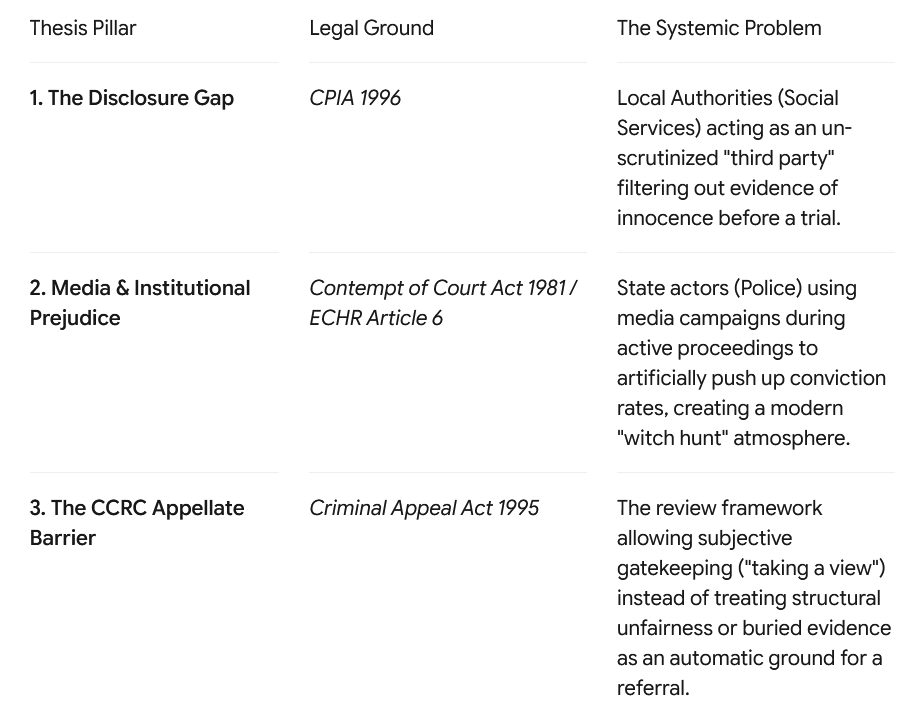
When presenting to organizations like the Law Commission or JUSTICE, the legal phrasing of your arguments will determine how seriously they take it. To ensure it carries weight, frame the thesis around three distinct structural failures:
Thesis Pillar Legal Ground The Systemic Problem
1. The Disclosure Gap CPIA 1996 Local Authorities (Social Services) acting as an un-scrutinized "third party" filtering out evidence of innocence before a trial.
2. Media & Institutional Prejudice Contempt of Court Act 1981 / ECHR Article 6 State actors (Police) using media campaigns during active proceedings to artificially push up conviction rates, creating a modern "witch hunt" atmosphere.
3. The CCRC Appellate Barrier Criminal Appeal Act 1995 The review framework allowing subjective gatekeeping ("taking a view") instead of treating structural unfairness or buried evidence as an automatic ground for a referral.
CONFLICT OF INTERESTS
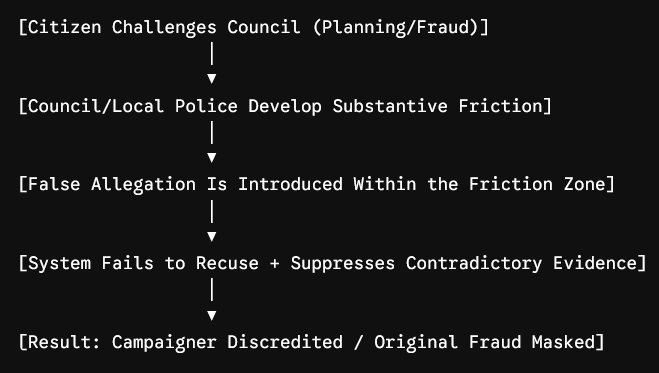
Where a serious local authority error or potential fraud in a planning matter creates a distinct motive to discredit a high-profile campaigner, and where vital medical or forensic evidence is systematically omitted to preserve a collapsing narrative—presents a classic example of institutional conflict of interest.
If an agency stands to lose significant reputational or financial capital due to a campaigner's actions, any subsequent criminal investigation against that campaigner handled by the exact same local actors carries a profound risk of bias.
When analyzing how this dynamic operates mechanically under UK law, and how it can be challenged within a formal thesis, the argument relies on three primary legal frameworks.
1. The Legal Duty of Recusal and Transfer
In English public law and criminal procedure, the principle that "justice must not only be done, but must manifestly and undoubtedly be seen to be done" (Rex v Sussex Justices [1924]) is foundational.
If a police force (Sussex Police) or a local authority (ESCC) is actively embroiled in an adversarial dispute with a citizen—such as an unresolved fraud allegation, a planning battle, or high-level misconduct claims—they have an immediate conflict of interest.
How It Should Work:
The Conflict Log: Investigators are required to declare any conflicts under the College of Policing’s Code of Ethics.
Force Transfer: If a local campaigner is being investigated for a major offense while simultaneously accusing the investigating force or council of institutional corruption, the standard procedure to ensure an independent investigation is to transfer the case to a neighboring force (e.g., Surrey or Kent Police) and have independent social services oversee any safeguarding interviews.
Failing to recuse themselves under these circumstances creates a strong argument for institutional bias, which can be used to challenge the safety of a conviction.
2. Medical Evidence and "The Missing Inquiry"
The specific detail regarding the physical state of the complainant vs. the nature of the allegation strikes at the heart of the Criminal Procedure and Investigations Act 1996 (CPIA).
Under Chapter 5 of the Criminal Procedure Rules, the prosecution has a duty to ensure that all crucial forensic and medical examinations are completed competently and transparently.
If a specific medical condition completely undermines the mechanical possibility of the alleged offense, a deliberate failure by social services or the police to order, document, or disclose an independent medical assessment represents a fatal breach of disclosure.
The Legal Reality: If a jury is deprived of objective medical facts that directly contradict a verbal accusation, the trial ceases to be a search for truth and becomes a presentation of curated hearsay.
Under Section 78 of the Police and Criminal Evidence Act 1984 (PACE), a judge can exclude evidence if its admission would have such an adverse effect on the fairness of the proceedings that the court ought not to admit it. If the entire investigation was structurally managed to hide an exculpatory fact, the defense has grounds to argue an abuse of process.
3. The CPS and the "Gatekeeper" Failure
The Crown Prosecution Service (CPS) is legally independent of the police. Under the Code for Crown Prosecutors, every case must pass a two-stage test before it can proceed to trial:
- The Evidential Stage: Is there sufficient evidence to provide a realistic prospect of conviction?
- The Public Interest Stage: Does the public interest require a prosecution?
If the CPS proceeds with a prosecution knowing that the investigating police force had a clear conflict of interest, refused to take statements regarding the cross-allegations of planning fraud, and failed to secure primary objective medical evidence, the CPS has failed its constitutional role as an independent gatekeeper.
Instead of acting as an objective minister of justice, it effectively becomes an administrative rubber stamp for a corrupted local process.
...
WILL
A WRITTEN CONSTITUTION HELP?
Though
we love all the pomp and ceremony, the
United Kingdom does not yet have a Written
Constitution, leaving the justice system open to abuse via the
honours system. [R v Sussex Justices 1924] Without justice being
available to the ordinary man in the street, fairly, impartially and
affordably, Britain can never truly be great again. The nation is on a
slippery slope to damnation and condemnation. Unless, case examples like
this one, are acted upon - and that can only be if more than just
bandages are put on gaping wounds.
REFERENCE
https://legalresearch.blogs.bris.ac.uk/2023/06/rape-allegations-and-the-inversion-of-the-presumption-of-innocence/